
National Medal of Honor Museum design by Rafael Viñoly Architects


Project: National Medal of Honor Museum
Location: Arlington, Texas, USA
Architect: Rafael Viñoly Architects
Location: Arlington, Texas, USA
Architect: Rafael Viñoly Architects
Size: 12,100 gross square meters
Exhibit Creative Direction, Experience Design: G&A
General Contractor: Linbeck Group
Owner’s Representative: Irvine Team
Civil Engineer: Graham Associates
Landscape Architect: MPFP
Structural Engineer: schlaich bergermann partner (sbp)
MEP Engineer: ME Engineers, Inc.
Enclosure Consultant: Curtainwall Design Consulting
Lighting Designer: One Lux Studio
Theatre Planning Consultant: Schuler Shook
Acoustics Consultant: Cerami
Building Code and Life Safety Consultant: Jensen Hughes
Food Service Consultant: Young Caruso
Graphic and Wayfinding Consultant: focusEGD
Vertical Transportation Consultant: EWCG
Wind and Climate Consultant: CPP Wind
Exhibit Creative Direction, Experience Design: G&A
General Contractor: Linbeck Group
Owner’s Representative: Irvine Team
Civil Engineer: Graham Associates
Landscape Architect: MPFP
Structural Engineer: schlaich bergermann partner (sbp)
MEP Engineer: ME Engineers, Inc.
Enclosure Consultant: Curtainwall Design Consulting
Lighting Designer: One Lux Studio
Theatre Planning Consultant: Schuler Shook
Acoustics Consultant: Cerami
Building Code and Life Safety Consultant: Jensen Hughes
Food Service Consultant: Young Caruso
Graphic and Wayfinding Consultant: focusEGD
Vertical Transportation Consultant: EWCG
Wind and Climate Consultant: CPP Wind
Set into a five-acre tranquil landscape, the Museum complex’s primary building volume seemingly hovers above ground by 40 feet, supported by five concrete megacolumns, each representing a branch of the United States Armed Forces.
The National Medal of Honor Museum is a new 102,000 square foot landmark building designed by Rafael Viñoly Architects. Located in Arlington, Texas within the city’s Entertainment District which also includes AT&T Stadium and Globe Life Park, assuming a prominent position in the City’s cultural landscape. On its five-acre site, the Museum makes a strong statement in support of the Medal of Honor recipients it celebrates, and enhances and improves pedestrian accessibility and connectivity through and around the lakefront site.
The National Medal of Honor Museum is a new 102,000 square foot landmark building designed by Rafael Viñoly Architects. Located in Arlington, Texas within the city’s Entertainment District which also includes AT&T Stadium and Globe Life Park, assuming a prominent position in the City’s cultural landscape. On its five-acre site, the Museum makes a strong statement in support of the Medal of Honor recipients it celebrates, and enhances and improves pedestrian accessibility and connectivity through and around the lakefront site.
The Museum’s architectural design symbolizes both the weight of responsibility carried by Medal of Honor recipients and the inspirational virtues they embody— courage and sacrifice, commitment and integrity, citizenship and patriotism.
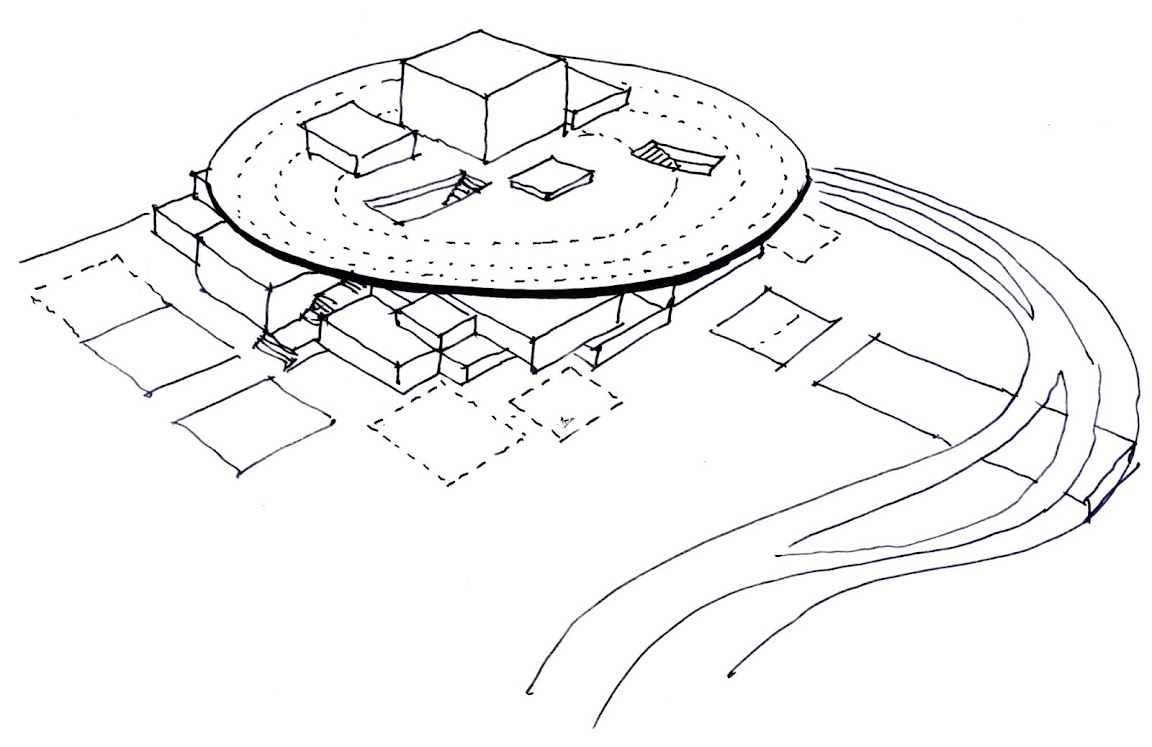
The centerpiece of the Museum is a metal-clad 200-foot by 200-foot box that appears to hover 40 feet above the landscape. This imposing volume and its rich materiality serve as a powerful representation of the heavy burden borne in battle by the Medal of Honor recipients. The box houses the Museum’s immersive exhibitions.
This volume is supported by five monumental megacolumns, each representing a traditional branch of the U.S. Armed Forces, symbolizing the collective strength and unity of our country’s service members. To represent the U.S. Space Force, a central oculus pierces the volume, introducing a dramatic source of natural light to the core of the composition.
Visitors enter through a ceremonial approach that descends into the Rotunda of Honor, a sunken open-air courtyard sheltered by the exhibition spaces above and open to the sky through the oculus. The Rotunda functions as a central gathering point and also as a place for formal and informal events.
The Ring of Valor is a continuous circular surface inscribed with the names of every Medal of Honor recipient that hangs above the circular lobby. It connects the megacolumns and reserves ample space to honor future heroic recipients.
Visitors ascend to the exhibits via spiral open-air stairs and all-glass elevators that offer views to the surrounding panorama. As the stairs and elevators reach the exhibit box, visitors enter the Orientation Gallery that leads to the main exhibits. The exhibitions are designed to accommodate both structured, linear journeys and self-guided, exploratory experiences, integrating micro and macro artifacts within immersive, interpretive, and interactive story-telling presentations.
At the Rotunda Level, the Museum hosts the Griffin Institute, an educational hub providing robust programs for teachers, students, business executives, and veterans, focusing on character-based leadership. The Institute features meeting spaces and the Col. Neel E. Kearby Theater, a state-of-the-art venue designed to seat 239 attendees. Further supporting the Museum’s event functions is Patrick Brady Hall, a 4,290-square-foot flexible event space for larger commemorative, celebratory, and educational events. Both venues feature views out across Mark Holtz Lake. An educational and curatorial center, retail, café, and administrative spaces are also located at this level.
Source: Rafael Viñoly Architects
m i l i m e t d e s i g n – w h e r e t h e c o n v e r g e n c e o f u n i q u e c r e a t i v e s
m i l i m e t d e s i g n – w h e r e t h e c o n v e r g e n c e o f u n i q u e c r e a t i v e s


TYPE OF WORKS

Most Viewed Posts











Since 2009. Copyright © 2026 milimetdesign. All rights reserved. Contact: milimetdesign@milimet.com